Random Thoughts on Super-Heroes & Comics


Super-Hero Definition & Types

Super-hero
An individual possessed of extraordinary or superhuman abilities, who usually has a secret identity, wears a distinctive costume (often skin-tight with a mask and cape), and who, without regard for personal safety or reward, fights criminals and other people, phenomena, or things which threaten harm to innocent citizens. Sometimes called mystery men or science heroes.

Heroes who lack superhuman powers are sometimes distinguished by the term “costumed crimefighter.”
Armored Hero
A gadgeteer whose powers are derived from a suit of powered armor, such as Iron Man & Steel.
Blaster
A hero whose main power is a distance attack, usually an “energy blast,” such as Cyclops & Starfire.
Brick (or Tank)
A hero, often grossly over-sized, with superhuman strength and endurance, such as the Thing, the Hulk, Colossus, Mr Incredible, the Tick, & Sasquatch.
Elementalist
A hero who controls an elemental force, including Storm (weather), Polaris (magnetism), & the Human Torch (fire).
Gadgeteer
A hero who invents special equipment that can mimic superpowers, such as Batman, Mr Fantastic, & Iron Man.
Mage
A hero skilled in the mystic arts, including Doctor Fate, Doctor Strange, Zatanna, the Spectre, Phantom Stranger, & the Scarlet Witch.
Marksman
A hero who uses projectile weapons, typically guns, a bow & arrows, or throwing blades, such as Green Arrow, Hawkeye, & the Punisher.
Martial Artist
A hero with phenomenal hand-to-hand combat skills. Some of these characters are actually superhuman (Iron Fist & Daredevil), while others are normal human beings who are extremely skilled and athletic, including Batman, Nightwing, & Captain America.
Mentalist
A hero who possesses psionic abilities, such as Professor X, Jean Grey, Saturn Girl, & the Shadow.
Shapeshifter
A hero who transforms his body in one or more of several ways, including a miraculous stretching talent (Mr Fantastic, Plastic Man, & Elongated Man), the ability to imitate the appearance of others (Mystique), or the power of metamorphosing into animals (Beast Boy).
Size changer
A shapeshifter who can alter his size, such as the Atom, Colossal Boy, Yellowjacket, & the Wasp.
Slasher
A hero who attacks with a blade or other thrusting/slashing weapon. Examples include Zorro & Wolverine.
Speedster
A hero possessing superhuman speed and reflexes, exemplified by the Flash, Quicksilver, & Impulse.
Healers
A hero who quickly recovers from grievous harm. Examples include Wolverine & Deadpool.
Original (or Paragon)
A hero with powers in several of the above categories. So-named because many of these heroes were among the first super-heroes to appear: Superman, Captain Marvel, Wonder Woman, the Martian Manhunter, Supergirl, Thor, the Vision, the Silver Surfer, Vartox, & Ms Marvel.

What Distinguishes a Hero from a Super-Hero?

Most of early literature details the exploits of heroes. Indeed, it was only with the advent of modern literature that common people became the subjects of novels & short stories. Since literature, legend, & myth are rife with heroes, what separates the modern creation, the super-hero, from the protagonists of yore?

The preceding definition mentions the possession of powers, often called super-powers. Does having these preternatural faculties make a hero a super-hero?

The Greek hero Herakles possessed godlike strength, superhuman accuracy with bow & arrow, and near-indestructibility. Yet he was not a super-hero in the modern sense. Herakles also wore the skin of the Nemean Lion, which he slew as his first Labor, and carried a trademark club. Did the wearing of a distinctive costume alone make him a super-hero? Again, the answer is “no.”

A super-hero generally possesses all of the traits mentioned in the above definition, but the crucial quality is that of the secret identity. Possession of a secret identity is what makes Batman & Captain America super-heroes even though they lack superhuman abilities.

The Lone Ranger & the Phantom, whose appearances predate that of Superman, both had secret identities. Were they super-heroes?

The Masked Rider of the Plains & the Ghost Who Walks were proto-super-heroes, but they were not fully actualized super-heroes. Although they wore masks to conceal their true identities, thus making their identities secret, they didn’t possess secret identities in the limited sense of the term in the context of the super-hero. A super-hero’s secret identity is, in fact, a dual identity. That is, the super-hero has two public identities, his true identity and his heroic (costumed) identity. In the hero’s true identity, he often feigns weakness, cowardice, and frivolity, while surreptitiously advancing the aims of his heroic self. Although the Phantom & the Ranger disguised their true identities, they did not act in those identities. It was as if their true identities no longer existed, with only their heroic identities in their place.

Sir Percy Blakeney, the Scarlet Pimpernel, whom Siegel & Shuster named as their primary influence in the creation of Superman, had a secret identity in the super-hero sense, but he, too, lacked an essential ingredient of the recipe and thus fell short of super-herodom himself. While Sir Percy had a dual identity, the Scarlet Pimpernel himself did not have a physical presence. That is, Sir Percy never appeared in public as the Scarlet Pimpernel. It was only after Sir Percy had fled the scenes of his illicit activities that the villains discovered the agency of the elusive Pimpernel. Sir Percy depended on disguise, stealth, and clever misdirection to accomplish his goal of whisking away French nobles from under the noses of Robespierre’s Committee.

El Zorro, however, supplied the missing link and qualified as a true super-hero—the first, in fact. Don Diego, also inspired by the Pimpernel, had a dual identity and made appearances as Zorro wearing a mask and distinctive garb.

What of Reed & Sue Richards & the other members of the Fantastic Four whose identities are public? They have costumes and super-powers. Do they not qualify as super-heroes due to their deficiency in the secret identity column?

I would submit, the answer is, again, “no.” Reed, Sue, Johnny, Ben, the Incredible Hulk, and a few others with public identities live in a super-hero universe (the Marvel Universe) and are, therefore, variants on the prevailing theme of the world in which they live. And that theme is the theme manifested by the Man of Steel in 1938, the theme of the super-hero.


A Timeline of the Evolution of the Super-Hero


The Golden, Silver, & Bronze Ages of Super-Heroes

When Jerry Siegel and Joe Shuster created Superman, they did more than create the first and greatest costumed, comic book super-hero. Based on the Scarlet Pimpernel, Buck Rogers, and Doc Savage, Superman is the archetypal costumed crimefighter on whom all others are based. Superman’s introduction in Action Comics #1 in June, 1938 immediately spawned a host of imitators, including Batman, the original Flash and Green Lantern, Captain Marvel, Captain America, Hawkman, Aquaman, and Wonder Woman. Siegel and Shuster also paved the way to the future of comics. Although comic books exhibited many genres besides that of the super-hero in the 30s, 40s, and 50s, from the 1960s to the present day, super-heroes dominate the medium.

In the late 40s and early 50s, the popularity of super-heroes waned. Some claim the decline was due to the end of the Second World War and the consequent desire to return to reality and normalcy; some name the publication of Sedction of the Innocent and the imposition of the Comics Code, which hobbled the plots of comics to the point of insipidity. Whatever the cause, many comic book titles & the careers of countless heroes came to a crashing halt. Only three super-heroes proved hardy enough to survive the end of the so-called Golden Age of super-heroes: namely, Superman, Batman, and Wonder Woman.

In the late 50s, DC Comics took advantage of a resurgence in super-heroes’ popularity by reintroducing classic heroes. They began with the Flash, giving him the same name and powers but a new costume, origin, and identity. DC continued this reinvention with Green Lantern, and soon many heroes of the Golden Age were reborn in this new Silver Age of heroes.

Marvel Comics exploited the trend with the introduction in 1961 of the Fantastic Four, essentially a copy of DC Comics’ new Justice League of America, which was itself an imitation of the Justice Society of the golden age. Included in the Fantastic Four was the Human Torch, a super-hero of the Golden Age, but he was given a new origin and identity after the fashion of DC’s new Flash and Green Lantern. Marvel rapidly spewed an array of new heroes and re-launched some Golden Age ones, such as Captain America & Namor.

In the early 1970s, amidst America’s tumultuous social and political awakening, comics began to reflect the times and the changes apparent in all media. Plots and artwork became more complex and realistic. Storylines incorporated socially relevant issues, and heroes suffered the consequences of a less innocent, grittier reality. Villains, such as Lex Luthor and the Green Goblin, became viler, not only by committing murders, an act seldom before encountered in the four-color pages of comics, but by killing characters central in the heroes’ lives. Thus began the so-called Bronze Age of heroes.


Cliched Super-Hero Attributes

Super-Hero Cape Mask Glasses Wig Name contains “man,” “boy,” “lad,” “woman,” “girl,” or “lass” Name contains the name of an animal Name contains a color Total Cliches
Superman Yes No Yes No Yes No No 3
Batman Yes Yes No No Yes Yes No 4
Green Lantern (Hal Jordan) No Yes No No No No Yes 2
Spider-Man No Yes Sometimes No Yes Yes No 3.5
Vartox No No No No No No No 0
Wonder Woman Sometimes No Yes No Yes No No 2.5
Iron Man No Yes No No Yes No No 2
Nightwing No Yes No No No No No 1
Supergirl Yes No No Yes Yes No No 3
Thing No No No No No No No 0
Shadowcat No Yes No No No Yes No 2
Black Canary No No No Yes No Yes Yes 3
The Hulk No No Sometimes No No No No 0.5
The Flash (Barry & Wally) No Yes No No No No No 1
Wasp No No No No No Yes No 1
Green Arrow No Yes No No No No Yes 2
Invisible Woman No No No No Yes No No 1
Marvel Girl No Sometimes No No Yes No No 1.5
Scarlet Witch Yes No No No No No Yes 2
Zatanna Sometimes No No No No No No 0.5
Mr Fantastic No No No No No No No 0
She-Hulk No No No No No No No 0
Wolverine No Yes No No No Yes No 2
Daredevil No Yes Yes No No No No 2
Silver Surfer No No No No No No Yes 1
Cyclops No Yes Yes No No No No 2


Imitation Super-Heroes

Original Super-Hero (or -Villain or -Team) Imitation Hero(es) Better (Best) Super-Hero
Superman Captain Marvel, Captain America, Thor, Wonder Man, Gladiator Superman
Supergirl Ms Marvel Supergirl
Batman Spider-Man, Daredevil, Wolverine Batman
Green Lantern Silver Surfer, Nova Green Lantern
Robin Bucky, Cyclops Robin
Solomon Grundy Hulk, The Thing, Beast, Colossus The Thing
Dr Sivana Lex Luthor, Dr Doom Lex Luthor
Brainiac Ultron Brainiac
The Atom Yellowjacket, The Wasp The Wasp
The Flash Quicksilver The Flash
Green Arrow Hawkeye Green Arrow
Namor Aquaman Namor
Darkseid Thanos Darkseid
Doctor Fate Doctor Strange Doctor Fate
Hawkman The Angel Hawkman
Human Torch Firestorm Human Torch
Red Tornado Vision Vision
Scarlet Witch Zatanna Zatanna
Black Canary Mockingbird Black Canary
Wonder Woman Storm, She-Hulk Wonder Woman
Joker Green Goblin Joker
Watcher Monitor Watcher
JLA Fantastic Four, Avengers JLA
Doom Patrol X-Men X-Men


Super-Hero Weddings

Aquaman #18 (Nov 1964)

Wedding of Aquaman & Mera


Fantastic Four Annual #3 (1965)

Wedding of Mr Fantastic and Invisible Woman


The Flash #165 (Nov 1966)

Wedding of the Flash & Iris West


Avengers #60 (Jan 1969)

Wedding of the Wasp & Yellowjacket


Giant-Size Avengers #4 (Jun 1975)

Wedding of the Scarlet Witch & the Vision


All-New Collectors’ Edition #C-55 (1978)

Wedding of Lightning Lad & Saturn Girl


Justice League of America #157 (Aug 1978)

Wedding of the Atom & Jean Loring


Legion of Super-Heroes Annual #2 (1983)

Wedding of Karate Kid & Princess Projectra


X-Men #175 (Nov 1983)

Wedding of Cyclops & Madelyne Pryor


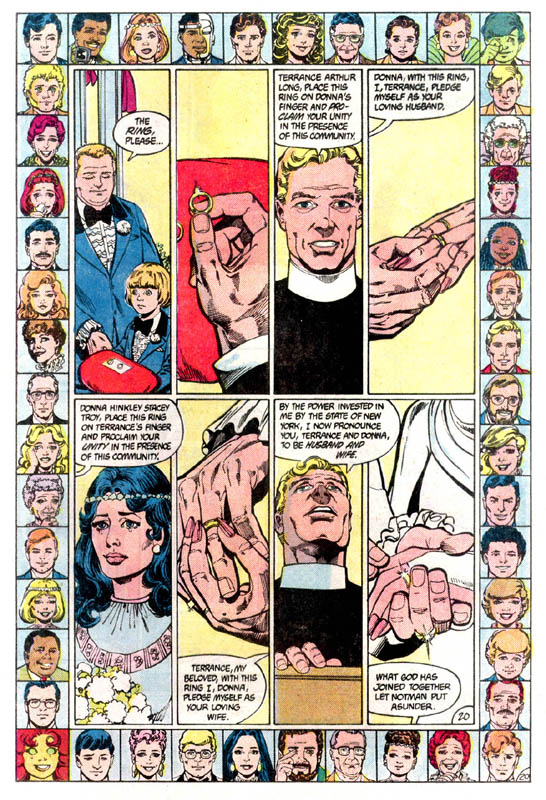
Tales of the Teen Titans #50 (Feb 1985)

Wedding of Wonder Girl & Terry Long


Incredible Hulk #319 (May 1986)

Wedding of the Hulk & Betty Ross


Fantastic Four #300 (Mar 1987)

Wedding of the Human Torch & Alicia Masters (the Skrull)


Amazing Spider-Man Annual #21 (1987)

Wedding of Spider-Man & Mary-Jane Watson


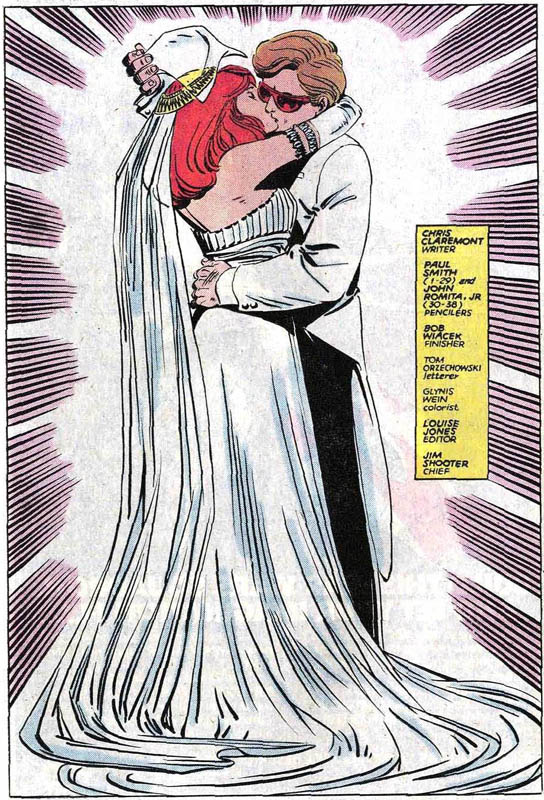
X-Men (Vol. 2) #30 (Mar 1994)

Wedding of Cyclops & Marvel Girl


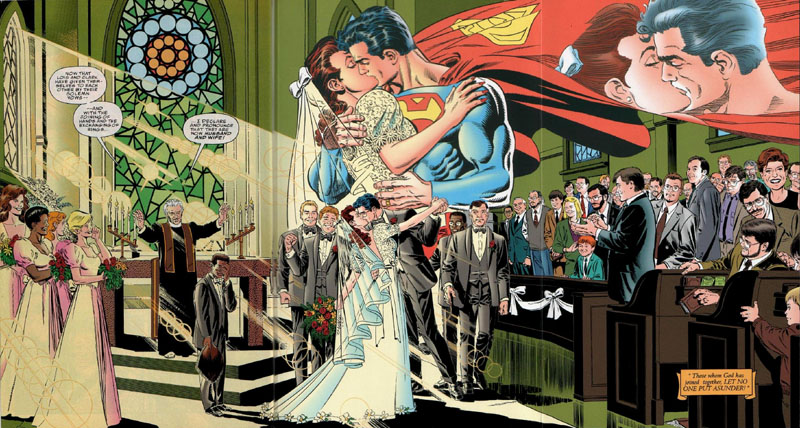
Superman: The Wedding Album #1 (6 Oct 1996)

Wedding of Superman & Lois Lane


Excalibur #125 (Oct 1998)

Wedding of Captain Britain & Meggan


Black Panther (Vol. 4) #18 (Sep 2006)

Wedding of the Black Panther & Storm


The Green Arrow/Black Canary Wedding Special #1 (Nov 2007)

Wedding of Green Arrow & Black Canary


To What Genre of Fiction (or Film) Does the Super-Hero Tale Belong?

The great Isaac Asimov had this to say concerning the fantasy genre in general and super-heroes in particular:

“But there are all kinds of fantasy. There is ‘heroic fantasy’ in which the characters are larger than life. In this case, the outsize nature of the characters may be so enormous as to verge on the grotesque, as in the case of Superman or the other superheroes; or the characters may be so human in many ways that we find ourselves accepting them as real, as in the case of the elves and hobbits of Tolkien’s masterpiece. The so called ‘sword and sorcery’ tales, of which Robert E. Howard’s Conan saga is the progenitor, is a subdivision of this.”

Much as it pains me to disagree with the eminent Professor Asimov, his definition of “heroic fantasy” is out of line with what I know of the sub-genre, and it certainly would not include the masked, caped denizens of four-color comics. That minor objection notwithstanding, Asimov is not the first person I have heard claim that the super-hero genre is a sub-genre of fantasy. I wrestled for years over how to categorize super-hero films. And this was when the Superman franchise and the Batman franchise were essentially the only super-hero films around.

I wanted to call Superman science fiction because it involves aliens & space travel, but I was unhappy with calling Batman SF, despite its having some SF overtones. It just seemed more like an action film, and yet that too didn’t feel quite right. It was not until years (and several blockbuster super-hero movies) later, that I discovered the idea that the super-hero was a genre unto itself, and 1978’s Superman: The Movie was considered the first in the category.

But is the super-hero story fantasy?

Some of them surely are. Many super-hero tales involve magic, mythological gods, and magicians like Lord Satanis, Doctor Fate, Mr Mxyzptlk, and Zatanna. Some Batman stories and Punisher tales, however, are pure crime fiction or mystery. Many Superman & Green Lantern plots are science fiction. That they are products of the imagination and never have nor ever will really happen goes without saying, but all fiction is fantasy in this sense.

Some claim that Superman began as SF and became fantasy once he acquired the ability to fly. So the claim here is that a phenomenon caused by as-yet-unknown science is fantasy rather than SF. This is a very similar claim to the one made by Jules Verne about HG Wells’ fiction. Mr Wells dismissed the claim, and so have most latter-day critics & scholars of the subject. HG Wells wrote science fiction even though what he wrote about was not something that could be extrapolated from present-day science. Indeed, Dr Asimov himself wrote of telepathic robots, time travel on an infinite scale, and universes that operate under different physical laws from our own.

Does this make his work fantasy?

The answer I submit is “no,” and neither is Superman. They are both science fiction becuase they deal with SF topics: space travel, aliens, robots, the future, parallel universes, and the like.

The stories in super-hero comics range in genre from pure SF to horror to romance. I recall reading an issue of one of the Spider-Man titles in the 80s in which Peter Parker talked to Mary-Jane as they walked through a park (probably Central Park). That was the whole issue. No Spider-Man, no Doctor Octopus lurking in the bushes, no fighting, nothing. Just Pete talking to MJ about their relationship, and this was a few years before they got married. And it was a completely captivating issue. You didn’t even notice the absence of a quick change to Spider-Man or the complete lack of web-slinging of any kind until you thought about it later.

The point of commonality linking all super-hero yarns is merely the presence of super-heroes.

Thus, while the individual stories can be of any genre, the super-hero tale as a whole constitutes a genre of its own.


Comic Book Pet Peeves


#1

Idolizing Marvel Super-Heroes and Derogating DC Super-Heroes

Ultimately, this is a matter of taste. It’s like trying to prove that chocolate tastes better than vanilla. Either you like something, or you don’t. What irritates me is over and over I see, hear, & read people trying to prove that Marvel is better than DC. And this has been going on for years.

Now, I could produce reams of data, pie-charts, and graphs showing comics sales over the decades, box office returns adjusted for inflation, number of television epsiodes & specials produced & aired, lunch box & action figure sales, number of magazine & newspaper articles, ad infinitum to prove that DC characters have sold more comics, had more media exposure, & made a bigger impact on pop culture than Marvel characters. The bottom line here is than when it comes to international icon status, the only things that come close to Superman are Mickey Mouse, Sherlock Holmes, Robin Hood, ... and Batman.

Then there are the people who argue that Marvel comics have better art & stories. How can this be? The same artists & writers have been alternating between DC & Marvel since the sixties. Do they do better work only for Marvel? This is rather like saying that you prefer Stephen King’s Doubleday novels to his work for Viking Press.

Finally, there are those people who insist that various Marvel heroes would beat various DC heroes in a fight. Marvel Comics, as an institution, has made it clear in several editions of the Marvel Universe, role-playing games, various public statements, and most recently in the JLA-Avengers crossover mini-series that their heroes are generally less powerful than their DC counterparts. I only point this out to contest the claim that the Hulk is stronger than Superman. Superman has fought the Hulk at least three times in crossovers and won every time. Marvel’s philosophy seems to be that lower power levels make for greater realism. (Having a guy who can move skyscrapers around because he was in the middle of a nuclear explosion is not realistic, and no amount of power reduction will ever make it so.) This is largely irrelevant as heroes from the universes of both publishers routinely win over opponents who are more powerful. Thus even allowing that the Silver Surfer is mightier than the Man of Steel (a dubious claim at best), the outcome of a contest between them is still not a forgone conclusion. Pointing out that the Surfer can transmute elements and create tons of kryptonite is also irrelevant. Superman specializes in opponents who play to his weaknesses. A number of his foes are sorcerors, magic being anathema to Kryptonians. The Man of Tomorrow still prevails. Metallo has a kryptonite heart, and the Kryptonite Man constantly produces kryptonite radiations of extreme range & intensity. Ultimately, the outcome of such a fight would be based on popularity (as in the Wolverine-Lobo clash), and I shouldn’t have to point out which of the two has had at least two monthly or bi-monthly comic titles (and usually quite a few more) to his credit for 70 years, five major motion pictures, and four long-running television series chronicling his adventures. The Surfer can’t even claim to have had one title in constant publication for the 40 years of his existence.


#2

Pronunciation of Mxyzptlk

It’s pronounced Mix-yez-pit-el-ik, pretty much the way it’s spelled.

It’s not pronounced Mix-el-plik, despite years of the Super Friends saying it that way.


#3

Confusing Shazam with Captain Marvel

I’m talking about the DC (formerly Fawcett) Captain Marvel, not one of the various Captains Marvel of Marvel Comics.

The Big Red Cheese:


The hero’s name is Captain Marvel; the wizard who gave him his powers is named Shazam.

“Shazam!” is also what Billy Batson says to transform into Captain Marvel.

The confusion is due in part to the fact that some of the comic titles & television series featuring Captain Marvel have been named “Shazam!,” which is, in turn, due to copyright issues because of the Marvel Comics Captains Marvel.


#4

Thor & Hercules as Super-Heroes

Don’t get me wrong. I am fond of the Marvel versions of Thor & Hercules.

Marvel wove interesting, creative, often humorous, sometimes awe-inspiring tales around them.

However, there is something basically unoriginal about ripping a Norse god or Greek hero from his mythological roots, transplanting him into the 20th Century, giving him a secret identity (in Thor’s case, an identity remarkably similar to the Hulk’s & Captain Marvel’s), having him join the Avengers, and calling him a super-hero.

As a matter of taste, I much prefer Wonder Woman, Captain Marvel, or even the Demon, all of whom have origins based in mythology while being themselves fresh, original creations.


#5

Comics as junk literature

People often consider comic books to be juvenile & bereft of artistic or intellectual content.

This is untrue, and the attitude is gradually changing with comics receiving acknowledgment as a distinctive artform.

Some celebrated authors have been both fans of and contributors to comics, including Ray Bradbury, Stephen King, and Larry Niven.


Home