The Versions of Batman in the Comics & Other Media
 Original Golden Age Batman
Batman of the Movie Serials
Silver Age Batman
Batman Television Series
Bronze Age Batman
The New Adventures of Batman Animated TV Series
Check out Bats, Joker, Nightwing, & Ra’s al Ghul on my
Favorite Characters from Pop Culture Page.
See where the Dark Knight,
Joker,
Ra’s al Ghul,
Nightwing,
Selina,
Riddler,
Talia,
Batgirl,
Penguin,
Mr Freeze,
Two-Face, &
Robin
placed on my Top 50 Super-Heroes (& -Villains) Pages.
See why the Caped Crusader is a version
of Superman.
Original Golden Age Batman
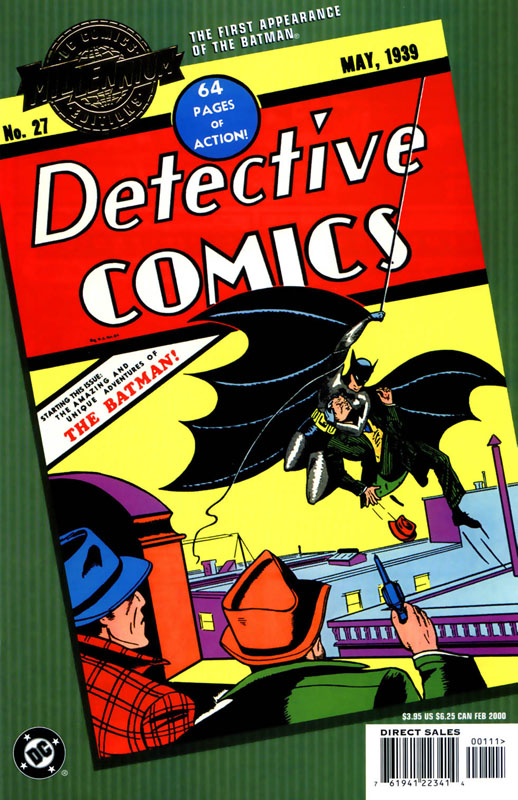

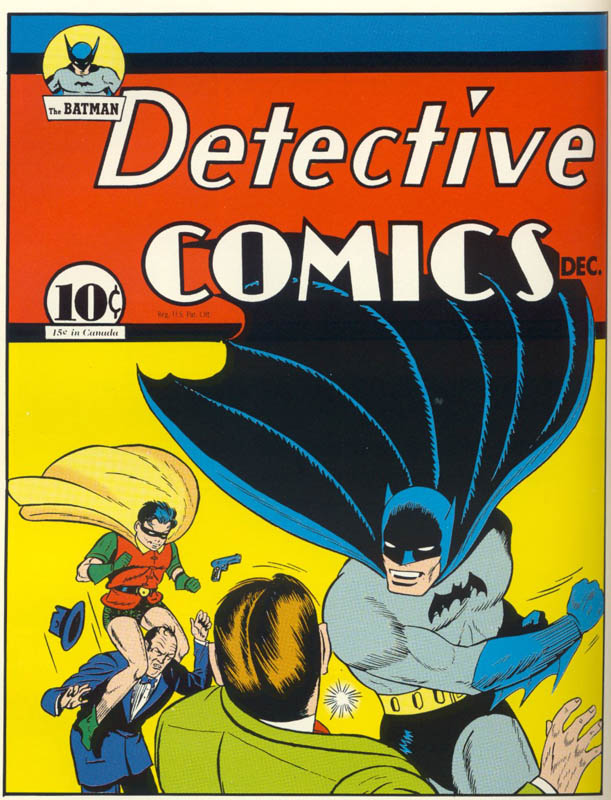

Created by Bob Kane & Bill Finger, Batman first appeared in Detective Comics #27 in May 1939, 11 months after the debut of
Superman. Detective Comics is DC Comics’ oldest, continuously
produced magazine & is, in fact, where “DC” originates.
The Caped Crusader has, like Superman, undergone a steady evolution over the years, but, unlike the Caped Kryptonian, Batman’s evolution has not consisted of
drastic fluctuations in type & amount of power, radical retconning of the origin story, & dramatic additions to supporting cast & rogues gallery. Indeed, since
Batman has no powers, his development could not focus on them, although the Dark Knight Detective’s skills & equipment have expanded leading to a noticeably
increased competency to battle crime. Furthermore, Batman did not have as much source material driving change. By the end of the 1940s, Superman had five comic
titles & by the end of the 1950s, Superman had seven comic titles to Batman’s three. Additionally, Batman did not have a 10-year radio serial to his name
& no TV series in the 1950s. So Batman’s evolution involves subtle changes in the tone, both of the tales & of the character of the Masked Manhunter himself.
Batman was based on the literary & cinematic Zorro, the pulp heroes Doc Savage
& the Shadow, &, in part, on the comic strip hero the Phantom.


The Golden Age Batman was a creature of the night who adopted the symbol of the bat to strike terror into the hearts of criminals. Commissioner Gordon, the
utility belt, the batarang, & the Batplane (actually a helicopter) all appeared within Batman’s first year of publication. Robin the Boy Wonder was
introduced in Detective Comics #38 in April 1940, & the Dynamic Duo was born. Robin’s commercial popularity inspired a slew of kid super-hero
sidekicks in other comic book titles. 1940 also saw the debuts of the Joker, Catwoman, Hugo Strange, & Clayface. In 1941, the Batmobile, the Penguin, & the
Scarecrow were introduced. Both Two-Face & the Bat-signal arrived in Gotham in 1942. Bruce Wayne hired Alfred in 1943. The Batboat was christened in 1946.
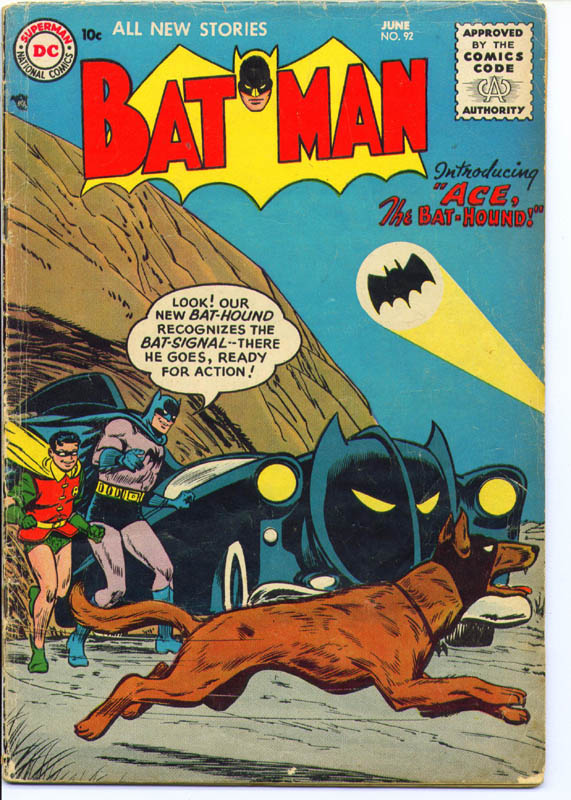
Vicki Vale, the Riddler, & the Mad Hatter premiered in 1948. Ace the Bat-Hound began prowling in 1955.
Therefore, the great bulk of the Batman mythos had been established well before the end of the Golden Age.
Batman was one of the DC Comics “trinity” to survive the mass extinctions at end of the Golden Age of comics in the late 1940s/early 1950s.


The Superman/Batman (World’s Finest) team appeared on The Adventures of
Superman radio serial before they went into action together in the comic books.
Toward the end of the radio serial’s run, Batman (&, often, Robin) was featured practically in every other storyline.
Batman of the Movie Serials


Like Superman, Batman inspired two 15-part movie serials of the 1940s. The first 15-part serial, entitled simply Batman, was released in 1943, stars Lewis
Wilson & Douglas Croft, pits Batman against a Japanese agent named Prince Daka, & was the first appearance of Batman & Robin apart from the printed page.
Batman also features Alfred & introduces the Batcave, which began to appear in the comics after the serial. The second serial, Batman & Robin
(1949), stars Robert Lowery & Johnny Duncan. This time the Dynamic Duo are up against the Wizard. Batman & Robin also features Commissioner Gordon & Vicki Vale.
Silver Age Batman


1956 marked the appearance of the Silver Age Flash & therefore, according to most, heralded the Silver Age of comics. As mentioned above, the Silver Age brought
few changes to the character of Batman, as well as few enhancements or new villains. The main difference between Batman’s Golden Age & Silver Age yarns,
is that in the Silver Age, Batman fights evil in the daylight, & evil takes on a decidedly B-movie science fiction cast. However, this is a general indictment
of all comics of the 1950s & early 1960s, the covers of which abound with strange aliens, bizarre giant monsters, & huge robots. The cover of
World’s Finest #117, below right, is a splendid example. This trend is mentioned more in connection with the Batman titles, because it is more
out-of-place with Batman, especially in light of his recent incarnations.


The following significant additions to Batman’s supporting cast & rogues gallery occurred in the Silver Age: Batwoman (1956), Bat-Mite & Mr Freeze (1959),
the original Bat-Girl (1961), Owlman (1964), Poison Ivy (1966), the new Batgirl (1967), & Man-Bat (1970).


Owlman is the evil Batman of Earth-3 (or Qward, the antimatter universe). He is a member of the Crime Syndicate of AmeriCa along with such villains
as Ultraman, Superwoman (an evil Wonder Woman), Power Ring
(Green Lantern), and Johnny Quick (the Flash). Owlman’s abilities are the same as Batman’s but his origin story is twisted.


In 1970, Batman discovered he too had an Earth-2 analogue in the person of the Golden Age Batman. The Earth-2 Batman is essentially the same as the Earth-1
Batman, with the same general abilities, history, & personality. The main differences between the Earth-2 Batman & his Earth-1 counterpart are that the Earth-2
Batman is about 20 years older, has married Catwoman, has had a daughter, Helena (Huntress), is police commissioner of Gotham, is a member of the Justice Society
of America rather than the Justice League, & never adopted the yellow circle around the bat-symbol on his costume. Additionally, the Joker killed the Earth-2 Batman in 1979.


Batman Television Series
From 1966 to 1968, Adam West & Burt Ward were Batman & Robin. Batman is one of those rare shows that you can love as a kid & watch years later to find you
still love it as an adolescent or an adult, but for entirely different reasons. Batman broke the Nielsen top 10 in its initial season, & remains the only
super-hero TV series to finish a year in the top 10. Batamania swept America in 1966. The Batman comic titles outsold Superman briefly, & the Dark Knight took over
The Brave & the Bold with issue #67 in late 1966 & retained it until the title’s cancellation in 1983.
Many hardcore Batman fans dislike the campy, satirical Adam West Batman.
I, too, am a Batman fan, who nevertheless considers the show to have been one of the best ever. Sure it pokes fun at super-heroes & comic books, but every
medium does this, even comic books themselves. Batman was also an homage to the Batman of the 1950s & the movie serials of the 1940s, & it catapulted
the Caped Crusader into the limelight of mainstream America to an extent Batman would not enjoy again until 1989.
The Batman series is solely responsible for the Barbara Gordon version of Batgirl & for pulling the Riddler (an obscure villain of the 1940s) out of
mothballs & making him a vital member of the Dark Knight’s rogues gallery.
First Season Favorite Episodes
“The Ring of Wax” (1x23) & “Give ’em the Axe” (1x24)


“Death in Slow Motion” (1x31) & “The Riddler’s False Notion” (1x32)


“The Joker Goes to School” (1x15) & “He Meets His Match, the Grisly Ghoul” (1x16)


“Instant Freeze” (1x07) & “Rats Like Cheese” (1x08)

“The Thirteenth Hat” (1x13) & “Batman Stands Pat” (1x14)
“The Curse of Tut” (1x27) & “The Pharaoh’s in a Rut” (1x28)
“Fine Finny Fiends” (1x33) & “Batman Makes the Scenes” (1x34)
Second Season Favorite Episodes
“The Penguin’s Nest” (2x27) & “The Bird’s Last Jest” (2x28)
“Hizzoner the Penguin” (2x17) & “Dizzoner the Penguin” (2x18)
“Hot off the Griddle” (2x03) & “The Cat and the Fiddle” (2x04)
“A Piece of the Action” (2x51) & “Batman’s Satisfaction” (2x52)
“An Egg Grows in Gotham” (2x13) & “The Yegg Foes in Gotham” (2x14)
“That Darn Catwoman” (2x40) & “Scat, Darn Catwoman” (2x41)
“The Joker’s Last Laugh” (2x47) & “The Joker’s Epitaph” (2x48)
“King Tut’s Coup” (2x53) & “Batman’s Waterloo” (2x54)
“The Cat’s Meow” (2x29) & “The Bat’s Kow Tow” (2x30)
“Green Ice” (2x19) & “Deep Freeze” (2x20)
“The Contaminated Cowl” (2x35) & “The Mad Hatter Runs Afoul” (2x36)
“The Catwoman Goes to College” (2x49) & “Batman Displays His Knowledge” (2x50)
“The Zodiac Crimes” (2x37) & “The Joker’s Hard Times” (2x38) & “The Penguin Declines” (2x39)
“Come Back, Shame” (2x25) & “It’s How You Play the Game” (2x26)
Third Season Favorite Episodes
“The Great Escape” (3x21) & “The Great Train Robbery” (3x22)
“Nora Clavicle & the Ladies’ Crime Club” (3x19)
“Surf’s Up! Joker’s Under!” (3x10)
Batman Film (1966)


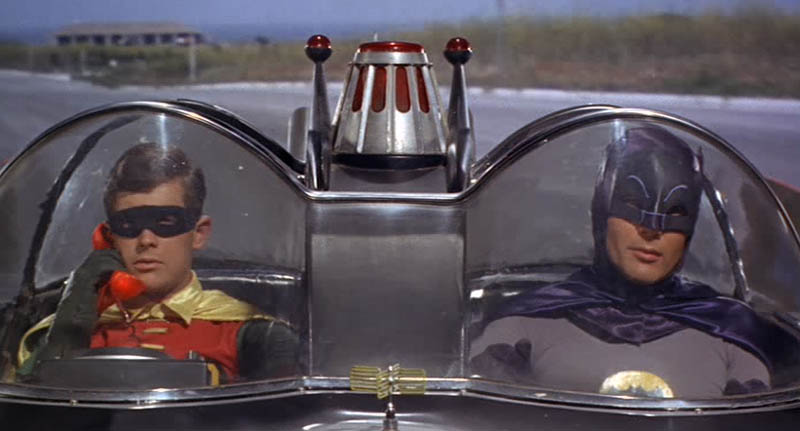
- Batman was produced in order to market the Batman series to international audiences, something that became superfluous with the
series’ unexpected, overwhelming success. The Batman film did not perform terribly well at the box office.
- Batman was directed by Leslie H Martinson, who also directed two episodes of the Batman series, 11 episodes of The Roy Rogers Show,
24 episodes of The Mickey Rooney Show, 18 episodes of Maverick, nine episodes of 77 Sunset Strip,
nine episodes of Mission: Impossible, 11 episodes of Love, American Style, six episodes of The Brady Bunch, eight episodes of Mannix,
three episodes of The Six Million Dollar Man (including “Day of the Robot” &
“The Bionic Criminal”), five episodes of
Wonder Woman, one episode of Buck Rogers in the 25th Century,
four episodes of Dallas, 26 episodes of Small Wonder, the 1967 Raquel Welch film Fathom, & many more films & television episodes alike.


- The Batman film features all four of the Dark Knight Detective’s primary antagonists—Joker, Penguin, Riddler, & Catwoman
(played by Lee Meriwether, as Julie Newmar had previous commitments).


- The film’s greater budget allowed several props, later used on the series, to be fabricated, which would otherwise have been prohibitively
expensive for television at the time—the Batboat, Batcopter, Batcycle, & the Riddler’s suit (as opposed to his tights).


Bronze Age Batman


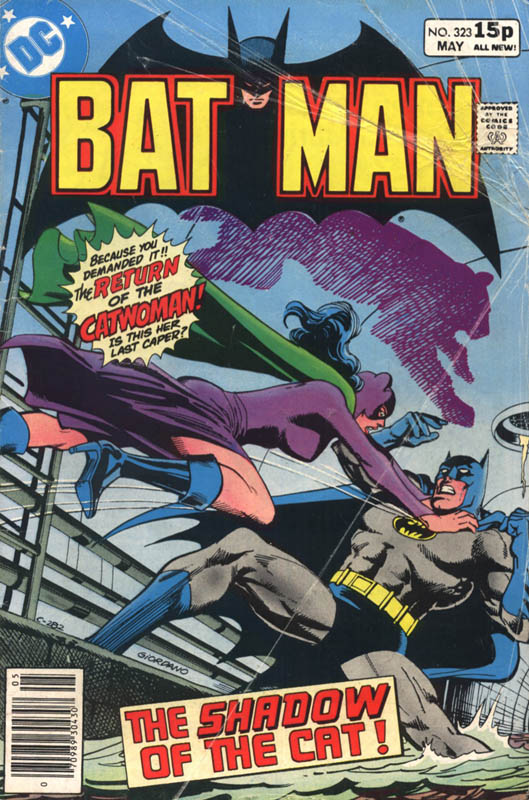
1971 is generally accepted as the year when the shift from Silver Age to Bronze occurred. With the end of the TV show, the comic book Batman received an overhaul
perhaps greater than any other DC character with the exception of Green Lantern & Green Arrow. Batman’s tone darkened; he was returned to his origins as a
creature of the night. Batman’s supporting cast, while still active, were pushed more into the background. Robin left Wayne Manor to attend Hudson
University in 1969. Thus, most of the Caped Crusader’s adventures became solo &, of course, far less SF-oriented. The Bronze Age saw the introduction of two
of the Dark Knight’s most popular nemeses, Ra’s al Ghul & Talia (1971), as well as the debut of that venerable institution Arkham Asylum (1974), & Killer
Croc in 1983. Supporting cast member Lucius Fox first appeared in 1979. Dick Grayson relinquished his Robin identity to Jason Todd in 1983 & became Nightwing in 1984.
The Joker even had his own title briefly in the Bronze Age.


The New Adventures of Batman


-
Filmation produced 16 30-minute episodes of The New Adventures of Batman, which originally aired on CBS on Saturday morning from February to May in 1977.


-
Interestingly, The New Adventures of Batman was produced concurrently with Hanna-Barbera’s
The All-New Super Friends Hour
, although the latter series did not air until the former had completed its first run. Hanna-Barbera was Filmation’s main TV animation competitor.
Although both series featured Batman & Robin, on Hanna-Barbera’s Super Friends the heroes were voiced by Olan Soule & Casey Kasem, who also
voiced the Caped Crusaders in Filmation’s 1968 series The Adventures of Batman. In Filmation’s new production, The New Adventures of Batman,
the Dynamic Duo’s voices were provided by none other than Adam West & Burt Ward.
-
Melendy Britt, notable as the voice of She-Ra, provided the voice of Batgirl in The New Adventures of Batman.


-
The New Adventures of Batman is notable for its cast of characters on several counts. First, it marks the first television appearance of Bat-Mite
who frequently appeared in Batman comic books of the early Silver Age. Second, the cast includes the Joker, which prohibited Hanna-Barbera’s
The All-New Super Friends Hour & Challenge of the Super Friends from including the Clown Prince of Crime. Third, although the Riddler appears
in the opening credits of The New Adventures of Batman (in a red costume), Filmation could employ neither the Riddler nor the Scarecrow in any of
The New Adventures of Batman episodes, because the two arch-villains had been licensed by Hanna-Barbera for inclusion in its 1978 show
Challenge of the Super Friends.
-
Additionally, the artistic style of The New Adventures of Batman is said to have been heavily influenced by those of famed Batman artists Dick Sprang & Neal Adams.


Top
Post-Crisis Batman through The Dark Knight
Home