Images of Japan I (2010-2012)
Japan


In 2010, the following about Japan were true:
- East Asian island nation directly off the east coast of the Korean Peninsula
- archipelago of 6,852 islands (but the islands of Honshu, Hokkaido, Kyushu, & Shikoku account for 97% of Japan’s land area)
- second-largest economy & 10th-largest population in the world
- capital city is Tokyo (although some confusion exists on this point) & the Tokyo Metropolitan Area is the most populous in the world
- native language is Japanese (Nihongo) & the Japanese word for Japan is Nihon (or, more emphatically, Nippon), which means “origin of the sun”—true from the perspective of other more western Asian countries, such as China
- indeed, the red circle on the flag of Japan represents the sun
- Japanese writing system consists of three separate logographic character sets—all ultimately derived from the Chinese writing system—with Kanji as the primary character set
- highest life expectancy in the world
- only world nation with a monarch whose title is Emperor (Tenno)
- 1947 constitution provides that the Emperor has no political power, invests the popularly-elected, bicameral parliament (National Diet of Japan) with legislative power as well as the power to elect the chief executive—the Prime Minister of Japan, & renounces the ability to declare war
- seismically & volcanically active with 108 active volcanoes
- Mt Fuji, at 12,388 ft, the highest peak in Japan, is an active volcano
- similar in land area to state of California
- highly mountainous with only 20-30% of its land area fit for human habitation
- nominally, the 36th-most densely populated country in the world, but this figure rises to fourth-highest when considering only nations of greater than 17,000 square miles, & in consideration of the afforementioned limitation on habitable area, possibly #1
Honshu
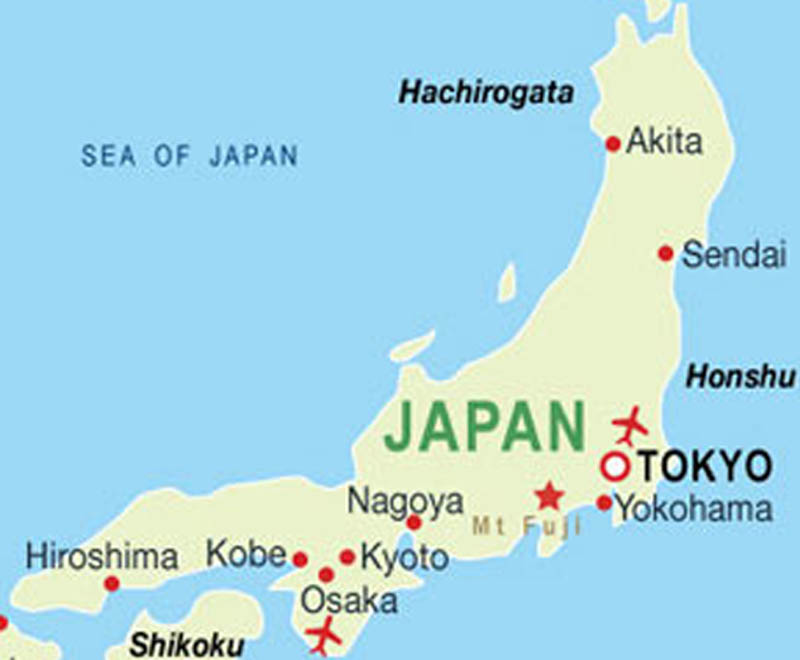
- seventh-largest island in the world & second-most populous island in the world
- larger than Great Britain & slightly larger than Minnesota
- represents 60% of the land area of Japan & contains 81% of the population
- similar in length to California but has just over half of the land area & over triple the population
- most-populous cities include Tokyo, Yokohama, Osaka, Nagoya, Kobe, & Kyoto
Religion
 Many Japanese people practice a combination of Shinto & Buddhism. Shinto is the indigenous religion of Japan. Shinto worship centers around kami,
which are gods, spirits of inanimate objects, & ghosts of ancestors. The establishments within which Shinto worship is practiced are referred to as “shrines” in English. In Japanese, Shinto shrines are called jinja. The Kanji character for jinja has an alternate pronunciation of -gu. Thus shrine names often end either in -jinja or -gu. Some shrines are also called taisha. The torii gate (see above) marks the boundary between the common & the sacred. A torii is normally posted at every entrance to a Shinto shrine. The torii consists of two uprights and two crossbars & is often bright red, as are most of the buildings within the shrine. Shinto, as Japan’s native faith, has a more nationalistic flavor about it than Buddhism. The Emperor is the highest Shinto authority, &, so, the torii,
itself a symbol of Shinto, has taken on the broader symbolism for the Imperial family & of Japan as a whole. Mountains are considered kami, &, as Mt Fuji is the tallest visible kami it, too, has acquired the iconic status of symbol of Japan.
Many Japanese people practice a combination of Shinto & Buddhism. Shinto is the indigenous religion of Japan. Shinto worship centers around kami,
which are gods, spirits of inanimate objects, & ghosts of ancestors. The establishments within which Shinto worship is practiced are referred to as “shrines” in English. In Japanese, Shinto shrines are called jinja. The Kanji character for jinja has an alternate pronunciation of -gu. Thus shrine names often end either in -jinja or -gu. Some shrines are also called taisha. The torii gate (see above) marks the boundary between the common & the sacred. A torii is normally posted at every entrance to a Shinto shrine. The torii consists of two uprights and two crossbars & is often bright red, as are most of the buildings within the shrine. Shinto, as Japan’s native faith, has a more nationalistic flavor about it than Buddhism. The Emperor is the highest Shinto authority, &, so, the torii,
itself a symbol of Shinto, has taken on the broader symbolism for the Imperial family & of Japan as a whole. Mountains are considered kami, &, as Mt Fuji is the tallest visible kami it, too, has acquired the iconic status of symbol of Japan.
As many Japanese people consider themselves both Buddhist & Shinto, they tend to separate the purviews of each, with Shinto concerning such life activities as marriage & birth, while Buddhism bears responsibility for funerals & other matters of death. Buddhist temples (not shrines!) in Japan do not usually have torii gates at the entrances, but they often have Shinto shrines within the temple grounds, & these shrines do display the torii. Nihongo for temple is tera; so temple names sometimes end in -tera, but they also often end in -ji, -in, or -do.
Buddhism was introduced into Japan from Korea around the Sixth Century AD. Different sects of Buddhism flowed from China into Japan over the following centuries, & some
achieved enough in popular appeal to culminate in the fused system practiced by many Japanese people today.
National Symbols
 The flag of Japan is, of course, a symbol of the nation, as are the torii & Mt Fuji (Fuji-yama or, more familiarly, Fuji-san). To this list, we must add the revered cherry blossoms, which bloom at slightly different times all across the country in the spring & are the cause of celebration & pageantry.
Camp Zama, Kanagawa, Japan

Notes:
Camp Zama—located in Zama City (Zama-shi), Kanagawa Prefecture (Kanagawa-ken)—was the Imperial Japanese Army Academy. Route 51 is a road to
Camp Zama that was specifically built for the Emperor to travel to review the graduating classes. The Showa Emperor, Hirohito, visited Camp Zama in 1937.
Yokohama, Kanagawa, Japan (Chinatown)

Notes:
Yokohama, capital of Kanagawa prefecture, is the second-largest city in Japan & lies just a few miles south of Tokyo. Yokohama Chinatown is the largest chinatown in Asia.
Mazu Miao Temple
Yokohama Kanteibyo (Guan Gong Temple)

Odawara Castle (Odawara, Kanagawa, Japan)


Notes:
The Late Hojo clan, or Odawara Hojo, was the powerful samurai family who built Odawara Castle & maintained it until they were defeated by the Taiko Toyotomi Hideyoshi in
1590. Hideyoshi then gave the castle to Ieyasu, the daimyo (roughly equivalent to a European duke) of the Tokugawa clan, who in turn gave it to the daimyo Okubo Tadayo,
who constructed the castle in its current form. Tokugawa Ieyasu was the Shogun whose rise to power is detailed in the eponymous James Clavell novel, under the name
Toranaga.
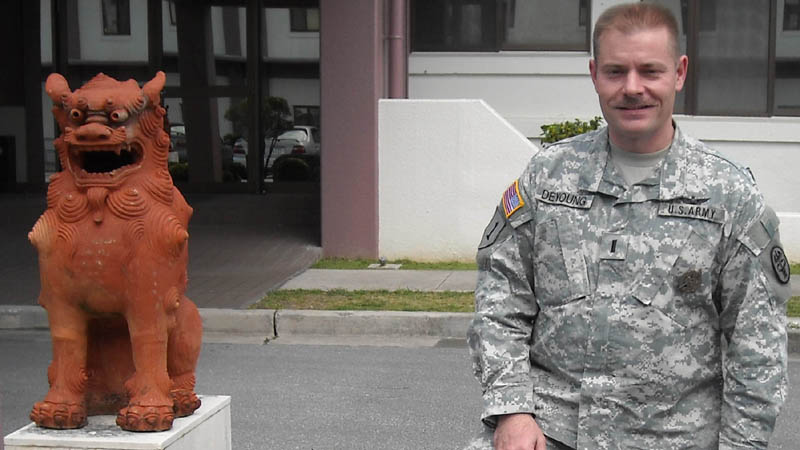
Torii Station, Okinawa, Japan

Notes:
Images of Japan Page II—Kamakura, Hakone, & Nikko
Images of Japan Page III—Kyoto
Images of Japan Page IV—Nara
Images of Japan Page V—Tokyo & Mt Fuji
Home